
Find the Biology That Separates Your Groups
MiraTyper types every cell in a section the same way across platforms and species, so the differences between conditions show up as measurements instead of impressions.
- One model types 425 cell types plus malignancy, with no reference set to curate
- Niche, community, and neighborhood structure quantified on top of consistent labels
- The same labels across single-cell, spatial, protein, and H&E data
Three Steps, Agreed Up Front
Type everything, consistently
Run one model across the study: 425 cell types on a standardized ontology, plus a malignancy score per cell, with no tissue-specific model selection.
Quantify the structure
Apply skills on top of the labels — niches, immune communities, lymphoid structures — so spatial organization becomes a set of numbers.
Compare and explain
Test which cell types, states, and structures differ between groups, and follow the signal back to the tissue it came from.
Measurements, Not a Verdict
Every number traces back to the region of the slide it came from, so the pathology team can check the work.
Consistent cell type calls
Every dataset in the study typed by the same model into the same ontology, with confidence scores.
Spatial structure metrics
Niches, communities, and neighborhoods quantified per sample rather than described qualitatively.
Differential analysis
Which types, states, and structures separate the groups, with the per-sample values behind each result.
Candidate morphological biomarkers
Features worth building into detectors for translational and clinical work.
What Has Actually Been Measured
MiraTyper is reference-free: there is no curated reference set to build or maintain, and no tissue-specific model to select. Custom cell types can be fine-tuned in under an hour.
Before You Book
Does it work on model organisms?
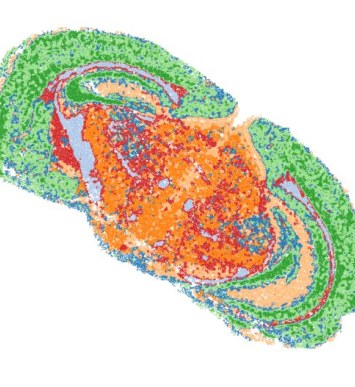
A mouse prototype types whole embryo and brain sections. Other species follow the same route: characterize the platform, then train, typically in days rather than months. Model-organism work is a prototype, not a released model.
What about rare or novel cell types?
Each prediction includes a confidence score, and low-confidence cells can be reviewed at a broader lineage level. Additional cell types can be added to the ontology and learned through fine-tuning on appropriate examples, with the updated model and labels versioned together.
How does it handle low-quality data?
The model reads the full panel rather than a few marker genes, which makes it robust to dropout, low sensitivity, and segmentation error. Confidence scores flag cells that should be reviewed.
Can we run it ourselves?
Yes. It ships as a Docker package that runs on a laptop, in the cloud, or inside an air-gapped network, with no data leaving your environment.
Run two datasets for free
Bring one asset and one decision. We will tell you on the call whether the tissue can answer it.
P.S. Consistent labels are what make every downstream comparison in a study mean the same thing.